
Last updated May 8, 2026
Creating a commercial floor plan no longer requires weeks of architectural back-and-forth or highly specialized technical knowledge. AI-powered planning tools now allow brokers, landlords, and business owners to generate and compare layout options quickly, helping stakeholders visualize a property’s potential earlier in the leasing or planning process. The most effective platforms combine speed with flexibility, practical design intelligence, and the ability to adapt layouts based on real operational requirements.
In the past, creating a floor plan was a mysterious, highly technical, and costly exercise. Thankfully, huge advances in AI technology and software have enabled tenants, landlords, brokers, and business owners to custom design a floor plan online in a fraction of the time.
The real estate planning process has been revolutionized, and concepts that nobody thought possible are suddenly not only possible but becoming the industry standard. The spatial planning sector may possibly be on the cusp of a new renaissance.
What used to require long planning cycles, multiple revisions, and extensive coordination can now begin with rapid layout generation and visualization. That shift is changing expectations across commercial real estate, particularly for teams trying to move quickly in competitive leasing or development environments.
What should floor plan software offer?
Most floor plan creators make a claim of being ‘quick and easy.’ And while speed and ease of use are critical, precision, versatility, and the ability to edit your designs are equally important.
Ideally, design software should be founded on sound design principles and should come with the backing of experienced architects. A platform may generate layouts quickly, but if the underlying planning logic is weak, the speed becomes less valuable.
The best floor plan software should help users evaluate possibilities, not just draw walls and desks. That means accounting for:
- workflow and circulation
- occupancy density
- access to natural light
- collaboration and focus areas
- future flexibility
- operational constraints
Increasingly, AI-driven planning tools are helping teams compare multiple options instead of refining a single concept repeatedly. This becomes especially valuable in commercial real estate, where stakeholders often need to evaluate different layouts for different tenant scenarios.
In some cases, this ability to visualize possibilities earlier has directly influenced leasing outcomes. Teams using AI-generated planning workflows have been able to accelerate decision-making and improve how spaces are presented to prospective tenants (as demonstrated in the SVR Commercial leasing case study).
Getting started on your floor plan
If you are a commercial real estate broker or you have commercial real estate for sale, you may be looking for ways to make your property more enticing to potential buyers or tenants. Offering a potential floor plan in the early stages of discussions is a great way to show the property’s potential.
Imagine the value that multiple layout plans could offer in helping a client visualize the property. Instead of asking prospective tenants to imagine what a space could become, you can show realistic configurations that support their actual operational needs.
This is one of the biggest shifts AI planning tools have introduced into commercial real estate marketing. A vacant floor is no longer presented as an empty shell. It becomes a flexible environment with visible possibilities.
For brokers, this changes the conversation from:
“Can you picture this working?”
to:
“Which of these layouts fits your team best?”
That difference matters.
Floor plan creators should prompt you for the parameters of your property, limitations that you would like to be taken into account, as well as special requirements or requests. In a post-pandemic society, heavy emphasis is placed on office population density, ventilation, and access to natural light.
Modern planning tools are also increasingly expected to support hybrid workplace strategies. Teams want layouts that can adapt over time rather than becoming obsolete after one organizational change.
In practice, flexibility has become just as important as aesthetics.
Is my design software any good?
What kind of technology powers your floor plan creator? Has it been tried and tested by industry leaders? Is it intuitive? And does it do some of the heavy thinking for you?
These questions are more important than ever because many online floor plan tools focus heavily on visual simplicity while offering limited planning intelligence underneath.
Some of the leading software available on the market today is powered by AI servers. These AI systems put a great deal of “thought” into creating your online floor plan. They take into account hundreds of factors and make thousands of calculations in order to generate optimized options.
Everything from acoustics to changes in the position of the sun can be calculated and presented for evaluation based on the priorities of yourself or your client.
The strongest tools do more than create attractive diagrams. They help reduce uncertainty early in the process.
That can have a meaningful operational impact:
- fewer redesign cycles
- faster stakeholder alignment
- clearer tenant conversations
- quicker leasing decisions
This is particularly important for larger office spaces, where even small planning inefficiencies can scale into expensive problems later.
In many projects, AI-supported planning workflows have dramatically increased planning capacity and accelerated turnaround time for design teams (as seen in Gindi Studio’s planning capacity expansion).

Why getting the free version doesn’t pay
Using the free version of a product may seem quite enticing at first. However, many users encounter an unpleasant surprise when they approach the final stages of their floor plan design project. Higher than expected premium prices or limitations on functionality can put a damper on both enthusiasm and commercial real estate profit potential.
This is especially common with software platforms that prioritize onboarding growth over long-term usability. The free version may allow simple experimentation but restrict the features that are actually necessary for meaningful commercial planning.
Even when starting for free, make sure to check the price of the premium version and confirm that going premium is actually worth your time and money.
A useful way to evaluate this is to ask:
- Does the premium version save meaningful time?
- Does it improve decision-making?
- Can it support real commercial workflows?
- Does it help present space more effectively to tenants or stakeholders?
Check that the added premium features are things that you actually need and are not simply mechanisms designed to encourage in-app purchases.
The cheapest tool is not always the most cost-effective one. In commercial real estate, speed, clarity, and presentation quality can directly affect leasing timelines and deal outcomes.
The best way to effortlessly create floor plans
Bringing your architectural vision to life should be a quick and easy process. The tool you choose should therefore be equal to the task of realizing it.
What increasingly separates modern planning platforms from traditional approaches is not just automation. It is the ability to compare possibilities quickly and make decisions earlier.
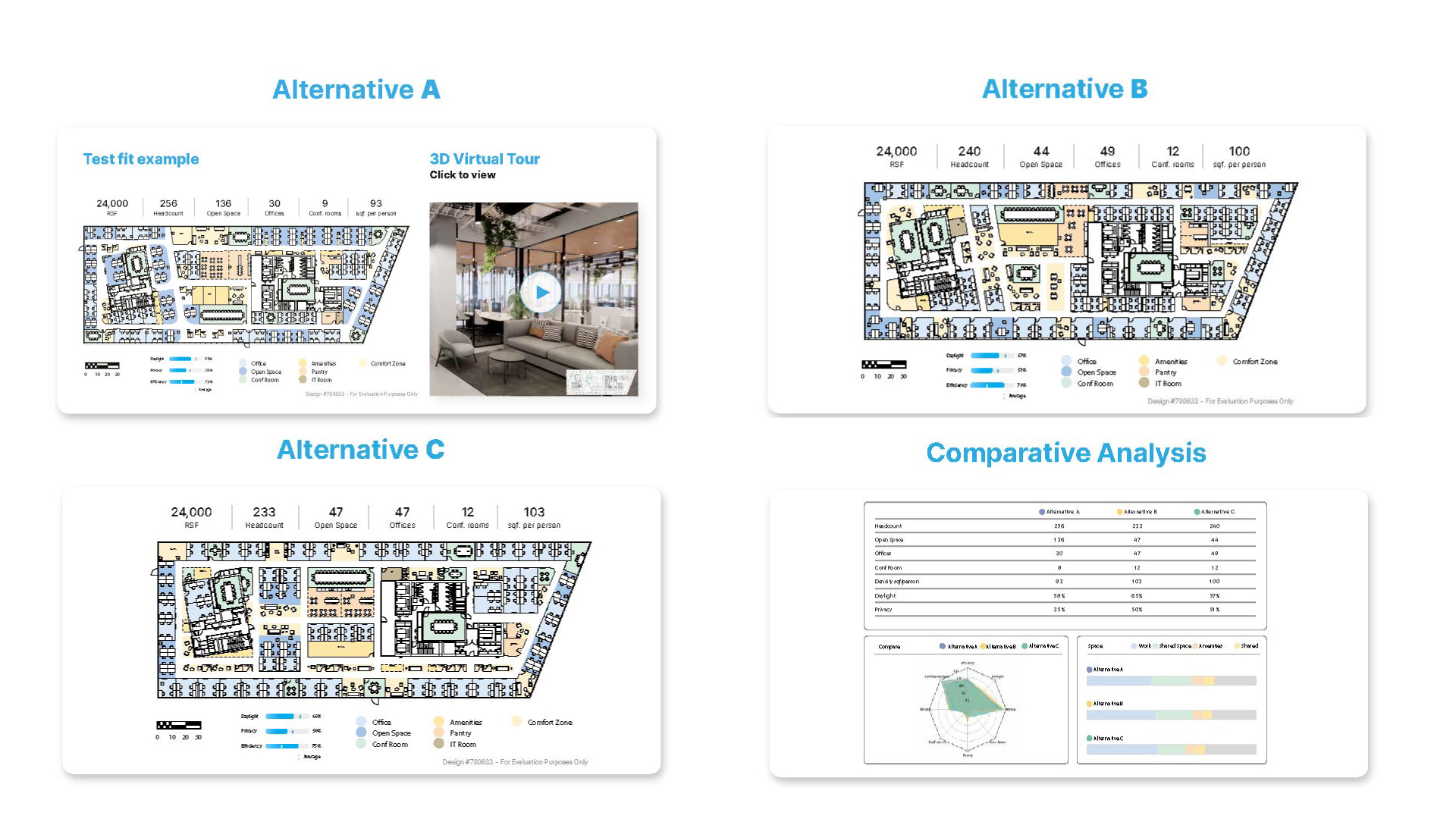
qbiq’s AI and design engines generate thousands of different plans and compare alternatives. This gives clients the most relevant and optimized results based on their requirements.
Plans are processed using machine learning (ML) and nonlinear programming to provide instant optimized planning. Instead of manually revising one layout repeatedly, teams can evaluate multiple directions simultaneously.
That shift changes how planning conversations happen.
Rather than debating hypothetical concepts, stakeholders can respond to concrete options supported by real spatial logic.
This becomes especially valuable when timelines are compressed. In several commercial real estate scenarios, AI-generated planning has helped teams move from concept to presentation in dramatically shorter timeframes (as demonstrated in JLL’s 24-hour delivery workflow).
qbiq brings its computing power to bear on your project needs. With three test fits and a virtual tour available within 24 hours, qbiq offers a significantly faster path from vacant space to actionable planning.
For brokers and landlords, this means:
- stronger property presentation
- faster tenant engagement
- better alignment during early discussions
- reduced delays in the planning process
For tenants, it means making decisions with greater confidence because the potential of the space is visible from the start.
Want to hear more about what qbiq can do for your business?
If you are evaluating office space, marketing a commercial property, or trying to accelerate planning decisions, exploring how qbiq’s AI-driven planning platform can support your workflow is a practical next step.
Instead of waiting weeks for layouts and revisions, teams can begin exploring optimized floor plan options within hours, helping conversations move forward earlier and with greater clarity.
Book a demo to explore qbiq’s AI software for planning






.png)


